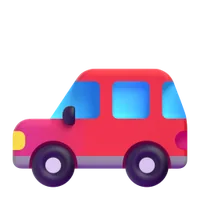
Land, water and air transport is how young children first learn that vehicles belong to different places. A bus runs on the road, a ship floats on the sea and an aeroplane flies in the sky. On this page your child taps a vehicle, hears its name in Hindi and English, and drops it into the right bin: Land (ज़मीन), Water (पानी) or Air (हवा). In Hindi, means of transport are called यातायात के साधन.
What your child learns about means of transport
The game uses fifteen vehicles that Indian and global children see in real life or in picture books:
| Where it moves | Vehicles in the game | How it moves |
|---|---|---|
| Land (ज़मीन) | Bus, car, bicycle, auto rickshaw, train, tractor, motorbike | Wheels on roads, tracks and fields |
| Water (पानी) | Ship, sailboat, boat, speedboat | Floats; pushed by wind, oars or an engine |
| Air (हवा) | Aeroplane, helicopter, rocket, parachute | Wings, spinning blades, fire, or floating down |
Sorting by where a vehicle moves teaches a child to group things by a rule, a key early science and maths skill. Your child also learns the names of vehicles in two languages, words like "on", "in" and "above", and why each vehicle is shaped the way it is: wheels for land, a floating body for water, wings or blades for air.
How to play the transport sorting game
- Vehicles appear at the top and bins sit below. Children aged 2-4 (set in the grown-up settings) see only two bins, Land and Water, because two groups are easier to hold in mind. Older children get all three.
- Your child taps a vehicle and Golu names it, for example "Auto rickshaw, ऑटो रिक्शा".
- Your child taps a bin. A right choice drops the vehicle in with a cheerful sound.
- A mistaken tap never hears "wrong". Golu first names the vehicle again, then the right bin glows, then Golu's finger 👆 points to it.
- After the rounds, a marble rolls into the Goli Jar. Tap the jar to count marbles together, which doubles as counting 1 to 10 practice.
The अ+A button sets the order of languages (Hindi first, English first, or one only). Calm sound, calm motion, captions, fewer choices and high contrast sit behind the grown-up check in settings.
Transport for toddlers, preschool, LKG and UKG
- Age 2-3: the goal is names and sounds. Say "bus goes vroom, boat goes splash". Play the two-bin game together. Our vehicles name for kids page is a good first step, with just tap and listen.
- Age 3-4 (nursery, LKG): land vs water is enough. Ask "Does it have wheels?" as a clue.
- Age 4-5 (UKG): all three bins. Ask "Why can't a car go in water?"
- Age 5-6 (class 1): tricky cases and reasons. Many class 1 EVS books have a chapter on means of transport, and this game matches it closely.
Children under 2 learn best with a grown-up, toy vehicles and the real street, not a screen. For older children, one short session played together is plenty, then head outside.
How to teach land, water and air transport at home
On the road
Every walk or school run is a transport lesson. Count buses, autos and bikes. In India your child might see a tractor, a cycle rickshaw or a bullock cart on the same road, which opens a talk about past and present. Keep road safety in the same breath: hold hands, stop at the kerb and look both ways. Our safety rules for kids page has more.
Bath time boats
Put a plastic boat, a toy car and a spoon in a bucket of water. Which floats? Which sinks? Your child discovers why boats are water transport and cars are not. Fold a paper boat together and blow it across the water like wind in a sail, a classic monsoon activity in India.
Look up at the sky
Aeroplanes leave white lines in the sky. Helicopters make a "chop-chop" sound. When you hear one, stop and look up together. This is the heart of the mission at the end of the game.
Sort toys into three places
Use three cloths: brown for land, blue for water and white for air. Your child places each toy vehicle on the right cloth. Draw the same three boxes on paper and your child can draw or glue vehicle pictures, a simple transport worksheet you make yourself. You can also print this page for the chart above.
Pretend play
Line up chairs as a bus or a train, with one child as the driver and the others as passengers buying tickets. Talk about the people who run our transport: the driver, the pilot, the captain and the conductor. Our community helpers page covers many of them.
Tricky questions children love
- Is a rocket air transport? Yes for this game. It flies up through the air and then into space, beyond the air.
- Is a parachute a vehicle? It is not a vehicle with an engine, but it carries a person through the air, so it goes in the Air bin.
- What about a seaplane? It lands on water but flies in the air. There are real vehicles that use two places, and a 6-year-old will enjoy debating them.
- Which is fastest? Of the vehicles here, a rocket is the fastest. For everyday travel, the aeroplane is the fastest way to go a long way.
Transport facts from India and around the world
- Indian Railways is one of the biggest railway networks in the world and carries millions of people every day.
- In Kerala's backwaters, people travel by boat the way others travel by bus, and houseboats are homes that float.
- The auto rickshaw, with three wheels, is a familiar sight in India and many Asian countries.
- India's space agency, ISRO, launches rockets from Sriharikota in Andhra Pradesh.
Tips for every kind of learner
- Praise effort: "You checked for wheels, clever thinking!" matters more than a perfect score.
- If your child is frustrated: go back to two bins in settings, or play with real toys instead.
- Speech delay or autism: the game needs only taps. Many children who love vehicles will stay engaged for longer here; keep the same routine and use calm sound if noise bothers them.
- Bilingual homes: some vehicle names are the same in Hindi and English (bus, car, train), which gives a bilingual child an easy win. Try the odd one out game next for more sorting.