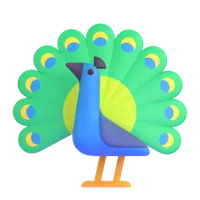
National symbols are the pictures a country chooses to say "this is us": a flag, an animal, a bird, a flower or a tree. This page shows young children the national symbols of 12 countries, starting with India (the tiger, the peacock and the lotus) and travelling to the USA, the UK, China, Japan, the UAE, Brazil, Australia, Germany, France, Mexico and Indonesia. Every symbol is a big Fluent picture, and every name and sentence is spoken in Hindi and English, so your child does not need to read.
What is a national symbol? (national symbols kya hai)
A national symbol is a thing that stands for a whole country. For a four-year-old you can say it simply: "Every country has a flag. Many countries also pick an animal, a bird or a flower that people love. When you see it, you think of that country." In Hindi, a national symbol is a राष्ट्रीय प्रतीक; the national animal is the राष्ट्रीय पशु, the national bird is the राष्ट्रीय पक्षी and the national flower is the राष्ट्रीय फूल.
Some symbols are made official by a law or a government order. Others are simply much loved and used everywhere, on stamps, coins and school books, without a law. The game is careful about this. When a symbol is officially designated, the voice says "the national bird of the USA". When it is a loved symbol without an official order, it says "a well-loved symbol of China". That small difference teaches older children an honest habit: check before you say "official".
National animal, bird and flower of 12 countries
This chart lists what your child sees in the game. "Official" means a law or government order names it; "loved symbol" means it is widely used but not formally designated.
| Country | Animal | Bird | Flower or plant |
|---|---|---|---|
| India | Bengal tiger (official, 1973) | Indian peacock (official, 1963) | Lotus (taught as the national flower) |
| USA | American bison (official national mammal, 2016) | Bald eagle (official national bird, 2024) | Rose (official national flower, 1986) |
| UK | Lion (loved symbol, on the royal coat of arms) | Robin (won a public vote in 2015; not official) | Rose (the flower of England) |
| China | Giant panda (loved symbol) | Crane (loved symbol) | Peony (loved symbol) |
| Japan | Snow monkey (loved symbol) | Green pheasant (called the national bird since 1947) | Cherry blossom (loved symbol) |
| UAE | Arabian oryx and camel (loved symbols) | Falcon (on the national emblem) | - |
| Brazil | Jaguar (loved symbol) | Rufous-bellied thrush (official national bird, 2002) and macaw | - |
| Australia | Kangaroo and koala (loved symbols) | - | Golden wattle (official national floral emblem, 1988) |
| Germany | - | Eagle (on the coat of arms) | Oak tree (loved symbol) |
| France | - | Rooster (loved symbol) | Lily, as in the fleur-de-lis (loved symbol) |
| Mexico | - | Golden eagle (on the flag) | Dahlia (official national flower, 1963) and the cactus on the flag |
| Indonesia | Komodo dragon (official national animal, 1993) | Javan hawk-eagle (loved symbol) | White jasmine (official national flower, 1993) |
A few pictures are close cousins rather than exact portraits: the jaguar is shown by a spotted big cat, the crane by a sarus crane, and small birds such as the robin, pheasant and thrush by a friendly bird picture. The names and sentences are exact.
National symbols of India for kids
Start at home. What is the national animal of India? The Bengal tiger, made the national animal in 1973 when Project Tiger began. What is the national bird of India? The Indian peacock (मोर), declared in 1963. What is the national flower of India? The lotus (कमल), which every Indian textbook teaches; the tiger and the peacock are the two that have a formal government notification. And what is the national tree? The banyan (बरगद), whose roots hang down from its branches.
For the full Indian set, including the flag, the emblem, the national anthem and the national fruit, play national symbols of India in Hindi and English. This page is the next step: it shows that other countries have symbols too.
How to play the national symbols game
- Countries: 12 flags in a grid. Tap a flag to open that country. Golu names the country and then each symbol, such as "The Bengal tiger is the national animal of India". Tap any picture to hear it again.
- Match: Golu shows a flag and asks "Which one is a symbol of Japan?" Your child picks from two to four pictures from different countries. The age setting decides how many.
A wrong tap never gets a buzzer. Golu says the name of what was tapped, then the right picture glows, then Golu's hand points to it. Finish a round of Match and a marble drops into the Goli Jar. Exploring five symbols in the Countries mode also earns a marble. The अ+A button in the header changes the order of Hindi and English, or plays only one of them.
What to expect at each age
| Age | What works | Try this |
|---|---|---|
| 2-3 | Naming the animals and birds; the idea of a flag | Tap India only. Roar like the tiger, dance like the peacock. |
| 3-4 (nursery) | India's tiger, peacock and lotus; one or two other countries | Match with two choices. Find the lotus in a picture book. |
| 4-5 (LKG) | Six to eight countries; "this country's bird is..." | Match with three choices. Draw the national bird of India. |
| 5-6 (UKG, class 1) | All 12; the idea of "official" versus "loved" | Match with four choices. Make a symbols chart for a school project. |
How to teach national symbols at home in 10 minutes
- Start with coins and notes. Indian coins and notes carry the Lion Capital emblem, and many other countries print animals and birds on their money. Hunting for them is a free real-world activity.
- One country a day. Open one flag, listen, then talk: "Which of these have you seen at the zoo? Which one lives in India too?"
- Act it out. Hop like a kangaroo, flap like an eagle, stretch slowly like a panda. Movement makes names stick for 3 and 4 year olds.
- Drawing for kids. A national symbols of India drawing is a common school task. Let your child draw the peacock or the lotus from the picture on screen, then add the Indian flag.
- Fancy dress. For a national symbols fancy dress competition, a tiger mask, a peacock feather crown or a lotus made from paper plates are simple, safe choices. Practise one line together: "I am the peacock, the national bird of India."
- Printable chart. There is no PDF, but the table above prints cleanly. Print this page and stick the chart near your child's desk.
Ask "which country?" questions in both directions: "Where does the kangaroo live?" and "What is Australia's animal?" Answering both ways is how children really learn a match.
Respect for every country
Children in the same class may have families from different countries. Invite them to share their own national symbols; if your child's family comes from a country that is not in the game, look up its flag and animal together. Keep the tone warm: every country loves its symbols, and no country's animal is "better". If your child gets tired or frustrated, stop after one country. Short, happy sessions of 5 to 10 minutes work best at this age, with a grown-up sitting alongside and talking about what you see. Children under two learn more from real animals, books and your voice than from any screen.
For children with speech delay, accept pointing: "Show me the tiger" counts as an answer. For autistic children, the same order every time helps, so start with India each day. In bilingual homes, let the child answer in whichever language comes first.
More to explore
After symbols, visit countries of the world for kids to see flags on a map, say hello in different languages, or learn the names of birds in Hindi and English and flowers in Hindi and English.
How to use this page at home
Say it, then find it
Play for a few minutes, then look for the same thing away from the screen: national symbols of countries on the shelf, in the kitchen, on the way to school. A child learns a word properly when they meet it twice, once on the screen and once in their hand.
Ten minutes is enough
Short and happy beats long and tired. Stop while your child still wants more, and come back tomorrow: the same page on five short days teaches far more than one long sitting. Nothing here is scored, so there is no reason to push.
Use both languages
Tap the language button at the top to hear the words in your home language first and the second language after. Hearing the same picture named in two languages is one of the few things research agrees builds attention as well as vocabulary.