Fruits Name in English and Hindi with pictures
30 words · tap 🔊 to hear each one.
| Picture | English | Hindi | Say it | Listen |
|---|---|---|---|---|
 | Mango | आम | Aam | |
 | Banana | केला | Kela | |
 | Apple | सेब | Seb | |
 | Orange | संतरा | Santara | |
 | Grapes | अंगूर | Angoor | |
 | Watermelon | तरबूज़ | Tarbooz | |
 | Papaya | पपीता | Papeeta | |
 | Guava | अमरूद | Amrood | |
 | Pineapple | अनानास | Ananaas | |
 | Strawberry | स्ट्रॉबेरी | Strawberry | |
 | Cherry | चेरी | Cheri | |
 | Lemon | नींबू | Neembu | |
 | Coconut | नारियल | Nariyal | |
 | Pear | नाशपाती | Naashpaati | |
 | Pomegranate | अनार | Anaar | |
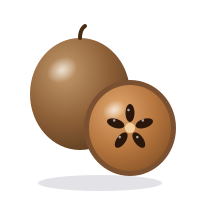 | Sapodilla | चीकू | Cheekoo | |
 | Peach | आड़ू | Aadoo | |
 | Muskmelon | खरबूज़ा | Kharbooza | |
 | Kiwi | कीवी | Kiwi | |
 | Green Apple | हरा सेब | Hara Seb | |
 | Blueberry | ब्लूबेरी | Blueberry | |
 | Lime | हरा नींबू | Hara Neembu | |
 | Jackfruit | कटहल | Kathal | |
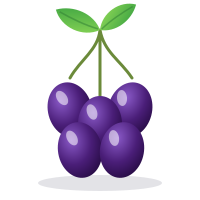 | Java Plum | जामुन | Jaamun | |
 | Lychee | लीची | Leechi | |
 | Custard Apple | शरीफ़ा | Shareefa | |
 | Plum | आलूबुख़ारा | Aaloobukhaara | |
 | Indian Gooseberry | आँवला | Aanwla | |
 | Dates | खजूर | Khajoor | |
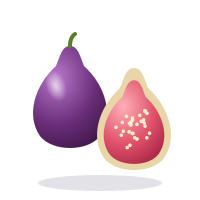 | Fig | अंजीर | Anjeer |
Fruits are one of the first word groups most children learn, because they can see, smell, hold and eat them. This page teaches 30 common fruits name in Hindi and English with pictures, from the everyday केला (kela, banana) and आम (aam, mango) to the seasonal जामुन (jamun) and शरीफ़ा (shareefa, custard apple). Every picture speaks both names in clear audio, so your child hears the Hindi and English word for the same fruit side by side.
What your child learns here, and at what age
Children do not learn all 30 fruits at once, and they do not need to. What changes with age is how many names they can hold and what they can do with them.
| Age | What is realistic | Try on this page |
|---|---|---|
| 2-3 (toddlers) | Understands 5-10 fruit names, says a few. Points when you ask "Where is the banana?" | Listen mode with you beside them. Easy fruits: mango, banana, apple, grapes |
| 3-4 (nursery) | Names 10-15 fruits in one language and some in the other. Starts sorting by colour | Find it with 2-3 choices. Talk about colour: "The banana is yellow" |
| 4-5 (LKG) | Names around 20 fruits, describes taste (sweet, sour) and size | Find it with more choices, then Memory pairs |
| 5-6 (UKG, class 1) | Knows 20-30 fruits in both languages, tells fruits from vegetables, starts reading the words | All modes. Read the word list together and point to the Hindi spelling |
This lines up with common school lists: about 10 fruits for nursery, 20 by UKG, and all 30 for class 1 or class 2 revision. Hindi-medium schools often call this topic फलों के नाम, and the game covers the same set.
How to use this fruits name game
The game modes
- Listen (सुनो): tap any fruit and hear its name. There is nothing to get right, so this is the place for toddlers and for new fruits.
- Find it (ढूँढो): Golu says "Where is the guava?" and shows 2-4 big pictures. A wrong tap never hears "wrong". Your child hears the name of the fruit they tapped, then the right one glows, then Golu points to it.
- Memory (जोड़ी): turn cards to find matching pairs of fruits. Good for 4-6 year olds who already know the names.
Language, marbles and calm settings
The अ+A button in the header changes the order of the two languages: Hindi then English, English then Hindi, Hindi only or English only. If you want your child to learn fruits name in Hindi first, pick Hindi then English. For a child who is at an English-medium school, English then Hindi works well. Every finished round drops a marble into the Goli Jar; tap the jar and count the marbles together. Behind the grown-up check in Settings you can set your child's age, which changes how many choices appear, and switch on calm motion, calm sound, captions, fewer choices or high contrast.
How to teach fruits name at home in 5-10 minutes a day
The screen is the starting point. Real fruit is where the words stick. Try one of these a day:
- The fruit basket game. Put three real fruits on the table. Name each one in both languages, then ask your child to hand you the संतरा (santara). Swap one fruit each day.
- At the mandi or the fruit cart. Ask "What colour is the papaya? Is it big or small?" Let your child pick one guava and hand over the bag. Shopping gives the words a reason.
- Touch and guess. Put a fruit in a cloth bag. Your child feels it and guesses. A spiky pineapple and a smooth apple feel very different.
- Cut and see. Cut a pomegranate, a papaya and a watermelon, and look at the seeds. This matches the facts Golu shares in the game.
- Colour sort. Sort fruits into red, yellow and green heaps. This links the fruit words to colours name in Hindi and English.
Say the Hindi word, pause, then the English word. Do not ask your child to translate. Hearing both names for the same real fruit is how bilingual children build words in both languages.
Fruits by colour, taste and season in India
This chart groups some fruits from the game in a way the word list above does not: by colour, taste and the time of year you will see them at the market. It makes a good talking chart for kids, and you can print this page.
| Fruit | Colour | Taste | Best season in India |
|---|---|---|---|
| Mango (आम) | Yellow | Sweet | Summer (April-July) |
| Watermelon (तरबूज़) | Red inside | Sweet | Summer |
| Lychee (लीची) | Red outside, white inside | Sweet | May-June |
| Jamun (जामुन) | Purple | Sweet and sour | Monsoon (June-July) |
| Custard apple (शरीफ़ा) | Green | Sweet | Autumn (Sept-Nov) |
| Orange (संतरा) | Orange | Sweet and sour | Winter |
| Guava (अमरूद) | Green | Sweet | Winter |
| Amla (आँवला) | Green | Sour | Winter |
| Banana (केला) | Yellow | Sweet | All year |
| Lemon (नींबू) | Yellow | Sour | All year |
Fun facts to share
- The mango is often called the king of fruits in India, and the mango tree is the national tree of Bangladesh.
- A strawberry wears its seeds on the outside. Count them together.
- Jamun turns your tongue purple. Children love checking in the mirror.
- A coconut has sweet water inside, and on festivals it is broken as an offering.
- Dates (खजूर) grow on tall palm trees and are eaten to break the fast in Ramzan.
How to write fruits name in Hindi (fruits name kaise likhate hain)
For 5-6 year olds who are starting to read, the easy fruits name in Hindi are the short ones without many matras: आम, अनार and केला. Show the word under the picture in the word list above, trace it with a finger, then write it on a slate. अनार is also the first word of the Hindi alphabet rhyme, so it links well to अ से अनार. For English, start with three-letter names like "fig" and short words like "lime" and "pear". Keep writing practice short: two words a day is plenty at this age.
Fruits name worksheet, chart and printing
You do not need a separate PDF. The word list above works as a fruits name chart with picture, English, Hindi and pronunciation for each fruit, and it prints cleanly from your browser: use Print and choose "Save as PDF" or paper. To turn it into a simple fruits name in Hindi worksheet, fold the printed sheet so only the pictures show, and ask your child to say the names. Older children can colour a fruit and write its name underneath, a quiet drawing and colouring activity. For a colouring page, try colouring pages for kids.
Fruits and vegetables for kids: telling them apart
A simple rule for 5-6 year olds: a fruit grows from the flower of a plant and holds seeds, and we usually eat it sweet. Vegetables are other parts of plants, such as leaves (spinach), roots (carrot) or stems. Tomato and cucumber confuse everyone, because by that rule they are fruits we cook like vegetables. Once your child knows these fruits, move on to vegetables name in Hindi and English and then the parts of a plant. Learning fruits and vegetables for kids works best side by side at the sabzi mandi.
How to get my 4 year old to eat fruit and vegetables
Many parents come to fruit words for this reason. A child who can name a fruit and has touched it is more willing to taste it. These ideas are gentle and pressure-free:
- Offer, do not force. Put a small piece of a new fruit next to a favourite one. It can take 10-15 tries before a child accepts a new food, so keep offering.
- Let them help. A 4 year old can peel a banana, pull grapes off the bunch or press a lemon. Children eat what they made.
- Play first. After a round of Find it, bring out the real fruit: "You found the papaya. Here is a real papaya. Want to smell it?"
- Eat together. Children copy you. Eat fruit in front of them and say how it tastes.
- Keep it plain. Whole fruit is better than juice for young children.
Which fruit is good for a child? Almost any fresh, seasonal fruit, cut to a safe size. For under-5s, cut grapes, cherries and other round fruits lengthwise into quarters, and take out seeds and stones. If you are worried about your child's eating or weight, talk to your paediatrician.
Keeping it happy: no pressure, every child
Praise the effort, not the score: "You listened so carefully" works better than "Clever girl". If your child gets frustrated in Find it, go back to Listen mode or turn on fewer choices in Settings. For children with a speech delay, pointing counts as an answer, so let them tap and you say the word. Autistic children often like the predictable Listen mode and the calm sound setting; let them repeat the same fruit as often as they like. In bilingual homes, speak the language you are most fluent in, and let the game supply the other. Keep screen sessions short, about 5-10 minutes, and sit with your child. Children under 2 learn fruit words better from a grown-up and a real banana than from any screen.
More to explore
Next, try food items name in Hindi and English for roti, dal and idli, or the memory game for more pairs practice. The seasons page connects well with seasonal fruits.